
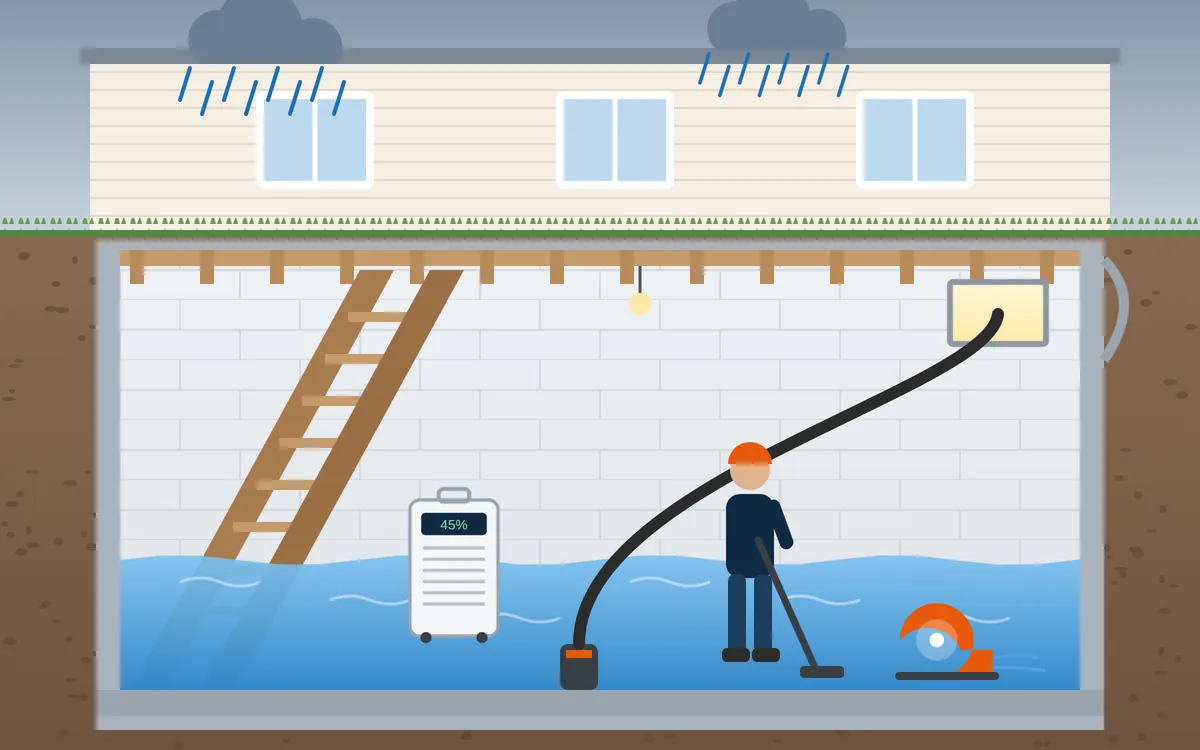
What are the main steps in a professional basement flood cleanup?
A professional crew follows the IICRC S500 water damage restoration process: assessment and classification, source containment, water extraction, selective demolition, structural cleaning, structural drying, moisture verification, and reconstruction. Each step has pass/fail criteria that are logged for the insurance claim.
Step 1: Assessment and Water Classification
The job starts with a walkthrough. The lead technician identifies the water source, measures the affected area in square feet, and classifies the water under the IICRC S500 system: Category 1 (clean supply water), Category 2 (gray, used), or Category 3 (black, contaminated, including sewage and most groundwater). Class is also assigned (1 through 4), which describes how much porous material is wet.
Category and class decide almost everything else: what gets saved, what comes out, how many air movers, how long drying runs, and whether PPE and containment are required.
Step 2: Source Containment and Scene Control
Power to the wet area is confirmed off. The water source is stopped. For sewage, plastic sheeting creates containment to keep contaminants inside the basement. HEPA air scrubbers may run from the start. Contents are moved to a dry staging area, either in the house or in a truck.
Step 3: Water Extraction
Truck-mounted extractors pull standing water and water from porous materials at hundreds of gallons per hour. For deep water, submersible pumps lead. For carpeted areas, weighted extraction tools pull water from both carpet and pad in one pass. By the end of extraction, no standing water remains anywhere, including behind kick plates, under stair stringers, and inside wall cavities accessible through outlet boxes.
Step 4: Selective Demolition (Flood Cuts and Material Removal)
Drywall gets a flood cut 12 to 24 inches above the water line. Baseboards come off. Wet fiberglass insulation comes out. Carpet pad comes out, and the carpet itself comes out if the water was Category 2 or 3. Particleboard built-ins, soaked cabinet toe-kicks, and damaged flooring are removed and labeled for the insurance scope.
Step 5: Structural Cleaning and Antimicrobial Application
Surfaces that touched contaminated water are cleaned with a detergent, rinsed, then treated with an EPA-registered antimicrobial applied at label strength. Framing, subfloor, and masonry get this treatment before drying starts. For sewage, this is the stage where the room transitions from contaminated to clean enough for drying equipment to run safely.
Step 6: Structural Drying
Air movers are placed to create a vortex around the wet materials. A commercial dehumidifier removes the moisture the air picks up. For saturated concrete or sealed hardwood, injection drying systems force dry air into the material through small ports. For wall cavities, flood cavity drying mats pull moisture out without opening the wall any further.
Step 7: Daily Moisture Monitoring
Technicians return daily, log moisture readings on a grid, check equipment, and reposition to chase slow spots. Readings are tracked against the dry standard — an equivalent reading on unaffected material elsewhere in the home. Drying is finished only when the numbers meet the standard for several consecutive readings, not when the surface feels dry.
Step 8: Final Moisture Verification and Final Walk
A final moisture map is produced, usually with a thermal camera overlay and pin meter readings documented at every monitoring point. The homeowner signs off on the drying portion before any reconstruction begins.
Step 9: Reconstruction
New insulation, drywall, trim, paint, flooring, and built-ins. Many crews also handle this, or hand off to a general contractor. The reconstruction scope should mirror the mitigation scope line for line so the insurance payment covers what was removed.
FAQs
What is the IICRC S500 standard?
It is the Standard and Reference Guide for Professional Water Damage Restoration, used by most insurance-approved restoration crews in the U.S.
How long does the full process take?
Clean-water basements usually run 3 to 7 days to dry and another 1 to 3 weeks for reconstruction. Sewage adds 1 to 3 days to the mitigation side.
Can I stay in the house during the process?
For clean water, usually yes. For sewage or black water, most crews recommend relocating until structural cleaning is done.
Do I need separate contractors for cleanup and rebuild?
Not usually. Most full-service restoration companies handle both. Ask whether the rebuild is in-house or subcontracted.
How does the crew document the job for insurance?
Daily moisture readings, photos, a scope of work with line-item measurements, and an equipment log. The insurer reviews these before approving payment.
What happens if drying stalls on day 3?
The crew opens the slowed area further (often a wall or floor) to find trapped water. This is a routine adjustment, not a setback.
Sources and further reading
- EPA: Brief Guide to Mold, Moisture and Your Home
- Colorado Division of Insurance
- National Weather Service, Boulder
- FEMA Flood Maps
- CDC: Flood water after a disaster
These public sources were used to check the safety, drying, and insurance information on this page.
Need basement flood cleanup in Colorado? Call to be connected with a crew in your area.
Call (800) 231-6861