
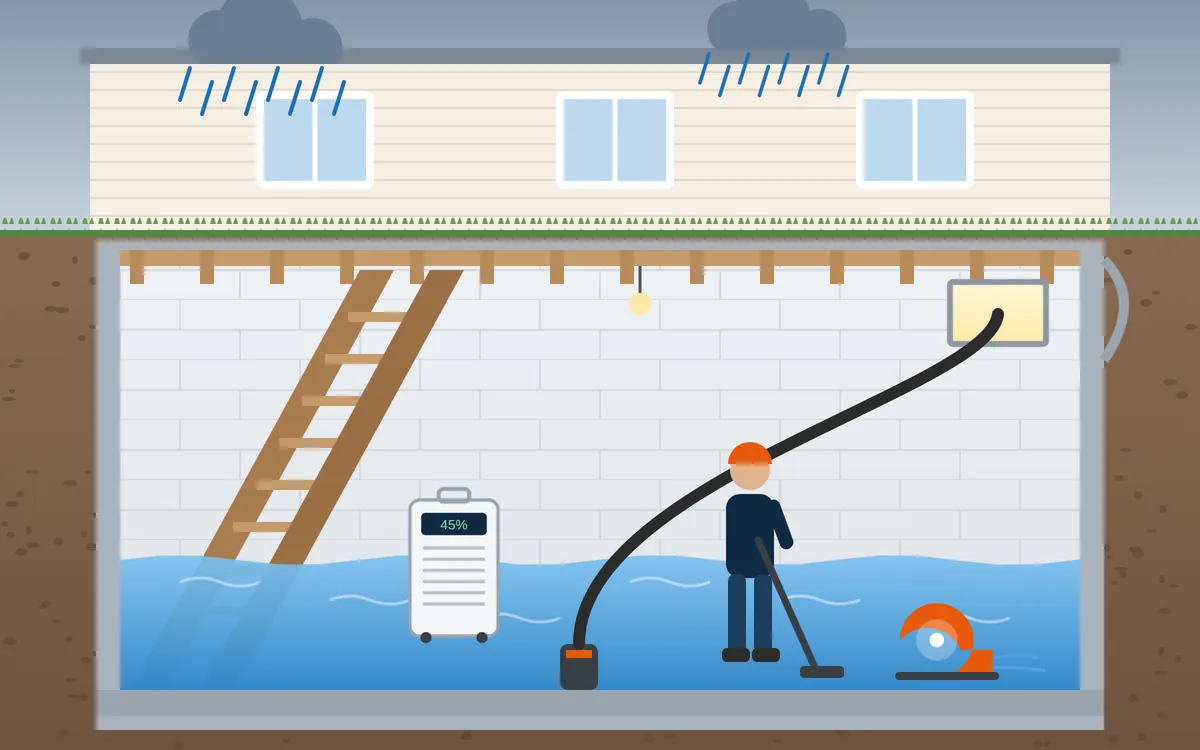
How do I properly dry a flooded basement?
Use commercial axial air movers and a low-grain refrigerant dehumidifier running continuously. One air mover for every 10 to 16 linear feet of wet wall; one commercial dehumidifier for every 1,000 sq ft of wet area. Close the room off, run for 3 to 7 days, and verify with moisture meters against a dry reference reading.
How Drying Really Works
Drying is the removal of moisture from materials by evaporation. Air movers accelerate evaporation by replacing the thin boundary layer of moist air at the material's surface. Dehumidifiers remove that evaporated moisture from the air so the room does not just become humid. Without the dehumidifier, air movers alone will not dry the room; they just move wet air around.
Air Movers: Count, Placement, and Angle
Commercial axial or centrifugal air movers run roughly 2,500-3,000 CFM. Place them along wet walls at a low angle (about 5-20 degrees to the wall) so air travels along the surface. Space them every 10 to 16 linear feet. In a corner, two air movers set 90 degrees apart create a vortex that dries the corner faster than a single fan would.
Dehumidifiers: Capacity and Placement
A residential dehumidifier pulls 30-50 pints per day. A commercial LGR (low-grain refrigerant) unit pulls 100-240 pints per day and can keep working in drier air where residential units stall. Place the dehumidifier centrally, with the exhaust pointed back into the room. Drain the condensate to a floor drain or a condensate pump.
Seal the Space
Close the basement door and seal gaps at the top of stairs with plastic if needed. Opening the basement to the whole house dilutes the drying effort over a much larger volume of air. The goal is a controlled, closed drying chamber.
Moisture Monitoring
Take readings daily at the same spots. Pin meter into drywall at 2, 12, and 24 inches from the floor. Non-penetrating meter on the subfloor at a dozen points. A dry reference reading from unaffected material in the same house sets the target. Drying is finished when wet readings match the reference for two consecutive days.
Specialty Drying Methods
Wet wall cavities are dried with cavity drying systems that push dry air into the wall through small ports in the baseboard area, avoiding full demolition. Wet concrete is dried with heated air at a controlled low humidity. Hardwood floors are dried with specialty mats that bond to the floor and pull moisture through the surface. These methods require trained technicians and are built into IICRC S500 drying plans.
How Long Drying Takes
Clean water, unfinished basement: 2 to 4 days. Clean water, finished basement: 4 to 7 days. Sewage or black water, finished basement: 7 to 14 days including specialty drying. The number depends on initial saturation, air temperature, and how well the room is sealed.
FAQs
Can I use box fans instead of air movers?
Box fans move air at a fraction of the rate and at the wrong angle. They will not dry a wet basement on their own.
Do I need heat during drying?
Yes. Drying works best between 70 and 90 degrees F. Below 60, evaporation slows markedly.
How do I know drying is really done?
Moisture meter readings in the previously wet materials match a dry reference reading elsewhere in the house, for two consecutive daily checks.
Should I run the house HVAC during drying?
Only if the basement is closed off. Otherwise the HVAC moves humid basement air into the rest of the house.
Can I dry a basement with just a dehumidifier?
No. A dehumidifier alone pulls moisture from the air but cannot move moisture out of soaked materials fast enough.
What about opening the windows?
Only if outdoor humidity is lower than indoor. In Colorado's summer storms, that is often not the case.
Sources and further reading
- EPA: Brief Guide to Mold, Moisture and Your Home
- Colorado Division of Insurance
- National Weather Service, Boulder
- FEMA Flood Maps
- CDC: Flood water after a disaster
These public sources were used to check the safety, drying, and insurance information on this page.
Need basement flood cleanup in Colorado? Call to be connected with a crew in your area.
Call (800) 231-6861