
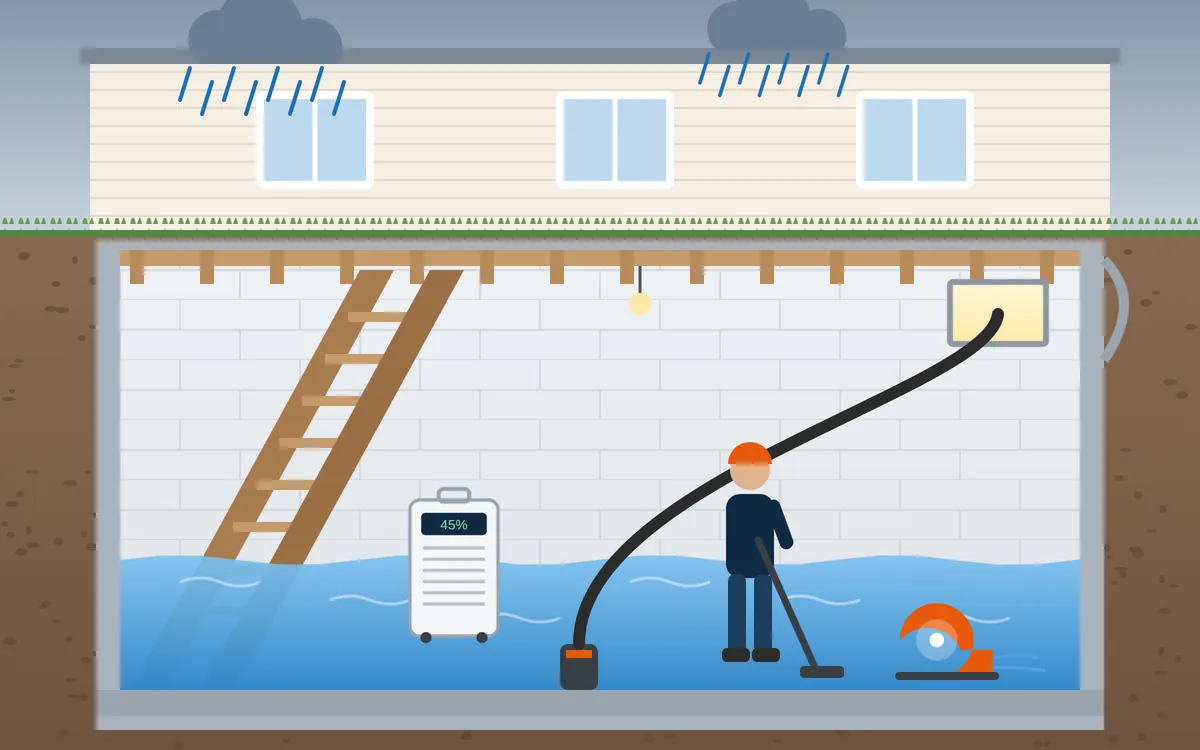
Why is the 48-hour window so important after a flooded basement?
Mold spores are everywhere, but they stay dormant until they find water. The EPA says mold can begin growing on wet building materials in 24 to 48 hours. Getting standing water out, unsalvageable materials cut away, and commercial drying running inside that window is what keeps a basement flood from turning into a mold remediation job.
Day 1 Goals: Safe, Dry of Standing Water, Demoed, Drying
The whole first day is about getting the basement into a state where drying can run without interruption. Safety first (power off, source stopped, PPE on), then extract every inch of standing water, then remove carpet pad, wet insulation, and drywall below the flood cut line. By bedtime on day one, air movers and a commercial dehumidifier should be running and the door should be shut.
End of Day 1: What Should Be Measured
Take a round of moisture readings before you leave for the night. Pin meter into the drywall at three heights, same spots each day. Non-penetrating meter on the subfloor at a dozen points around the room. Write them down with the time and a sketch. These are your baseline. Everything on day two is compared against them.
Day 2 Goals: First Drying Check, Equipment Repositioned, Mold Watch
Early on day two, read the meters again. Materials that are drying will show falling numbers. Spots that did not move need more airflow — reposition an air mover or add one. Spots that got worse mean a hidden pocket of water, often under a sill plate, behind an outlet, or in insulation that was missed.
Walk the room with your nose. A sharp, musty smell on day two is often the first sign of mold starting. Pay attention to the baseboard line, around stair stringers, and behind any bookshelves or cabinets that stayed in place.
End of Day 2: Decision Point
If moisture readings are moving in the right direction and there is no musty smell, the recovery is on track and drying continues for several more days. If any area is not drying or already smells, a professional restoration crew needs to open the wall or floor to find the trapped water. Letting a stuck pocket run into day three almost always becomes mold remediation.
When to Escalate to a Professional Crew
Call a crew by the 48-hour mark if any of these are true: the basement is larger than 200 square feet of wet area, the water was Category 2 or 3, drywall is wet above 24 inches, the moisture numbers are flat, or there is any musty smell. Our line connects Colorado homeowners with crews around the state: (800) 231-6861.
FAQs
What happens if drying starts after 48 hours?
The IICRC S520 standard treats materials wet longer than 48 hours as potentially contaminated and often non-salvageable, because mold growth is likely.
Can I run drying equipment for only part of the day?
No. Drying equipment is sized for continuous operation. Shutting it off at night allows the air to re-equilibrate and often adds a day to the total.
What does a musty smell on day 2 mean?
It usually means something is already starting to grow, often inside a wall cavity or under flooring. A crew needs to open it up.
Can I remove the equipment early if the floor feels dry?
A dry-feeling surface does not mean dry. Decisions should come from moisture meter readings compared to a dry reference spot.
Do I need to leave the house during the first 48 hours?
Only if sewage is involved, if the basement is the main living area, or if the drying noise and heat make it impractical to stay.
Is a professional required for every basement flood?
No, but 48 hours is the clearest decision point. If anything is still wet or smells off at hour 48, it is time to call.
Sources and further reading
- EPA: Brief Guide to Mold, Moisture and Your Home
- Colorado Division of Insurance
- National Weather Service, Boulder
- FEMA Flood Maps
- CDC: Flood water after a disaster
These public sources were used to check the safety, drying, and insurance information on this page.
Need basement flood cleanup in Colorado? Call to be connected with a crew in your area.
Call (800) 231-6861