
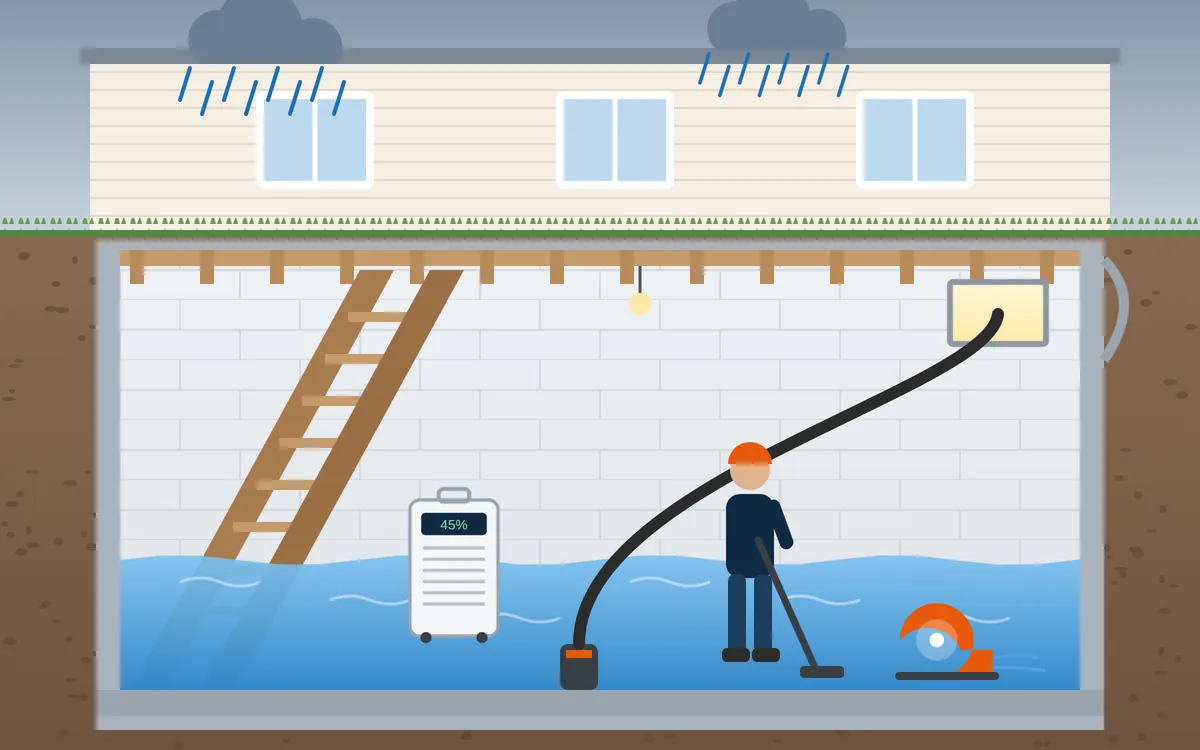
Do foundation cracks always cause basement flooding?
No. Many hairline cracks never leak. But any crack that reaches the exterior face of the foundation wall is a potential water path during storms or snowmelt. Horizontal cracks and stair-step cracks in block walls are more serious than vertical hairlines in poured concrete.
Types of Foundation Cracks
- Vertical hairline (poured concrete): Common from curing shrinkage. Usually cosmetic.
- Diagonal: Usually settling-related. May need monitoring.
- Horizontal: Serious. Indicates pressure from outside soil. May need structural repair.
- Stair-step (block walls): Serious. Indicates differential settlement.
- At corner or window: Stress concentration. Can widen over time.
Will This Crack Leak?
A crack leaks if three things are true: it extends through the full wall thickness, water is present on the outside face during storms, and there is no exterior waterproofing membrane. The first can be tested by a probe; the second is a given during Colorado spring runoff; the third requires inspection.
Sealing a Crack
- Hairline cracks: Hydraulic cement or epoxy injection kits from a hardware store ($30-$80).
- Larger cracks: Professional polyurethane or epoxy injection ($300-$900 per crack).
- Through-wall cracks: Exterior membrane repair ($1,500-$5,000+).
- Structural cracks: Carbon fiber straps or wall anchors with structural engineer sign-off.
When to Call a Structural Engineer
- Horizontal crack of any length.
- Any crack wider than a nickel's thickness (about 1/8 inch).
- Stair-step cracks in block walls.
- Visible bowing in a basement wall.
- Doors or windows upstairs sticking suddenly.
- Cracks growing year over year.
Structural engineer consultation runs $400-$800 in Colorado.
Colorado Clay Soil and Cracks
Front Range cities sit on expansive clay (bentonite-rich). The Colorado Geological Survey has mapped the problem. These soils expand when wet and shrink when dry, cycling foundation walls through stress each year. Most Colorado basement cracks are from this soil behavior, not from foundation defects.
FAQs
Can I ignore hairline cracks?
Monitor them. If they leak during spring runoff, seal. If they don't, mark the date on the wall with a pencil and check annually.
Will insurance cover foundation crack repair?
Usually not. Foundation cracks are considered maintenance, not sudden damage.
Is epoxy or polyurethane better for crack injection?
Epoxy structurally bonds; polyurethane flexes with the wall. Pros use them for different situations.
Can I seal a crack from the inside and stop water?
Interior sealing works for small cracks but can push water elsewhere or build pressure. Exterior waterproofing is more reliable.
How do I know if a crack is active or dormant?
Mark it with a pencil at the ends and date it. If it extends in a year, it's active.
Does a cracked foundation mean I can't sell my house?
No, but it will be disclosed and may affect price. Repair with engineer sign-off makes it a non-issue.
Sources and further reading
- EPA: Brief Guide to Mold, Moisture and Your Home
- Colorado Division of Insurance
- National Weather Service, Boulder
- FEMA Flood Maps
- CDC: Flood water after a disaster
These public sources were used to check the safety, drying, and insurance information on this page.
Need basement flood cleanup in Colorado? Call to be connected with a crew in your area.
Call (800) 231-6861