
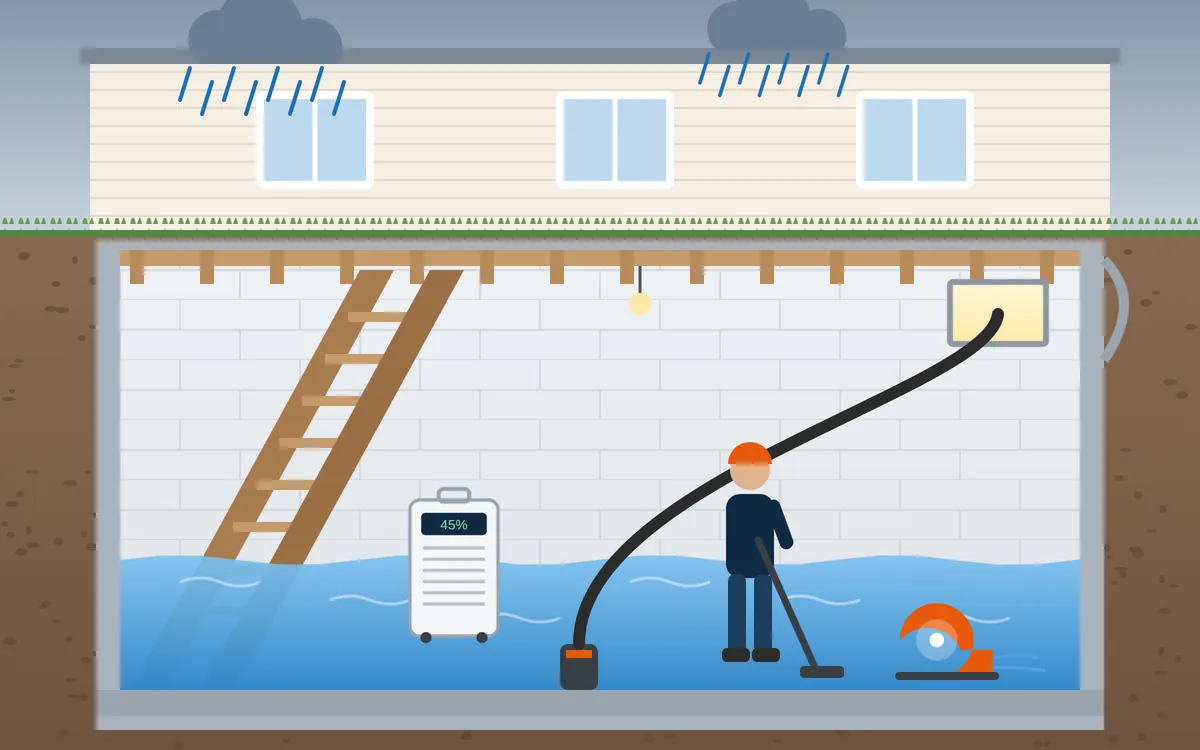
What equipment is used in professional basement flood cleanup?
Truck-mounted extractors (water removal), submersible pumps (deep water), axial air movers (airflow), LGR dehumidifiers (moisture removal), moisture meters (verification), thermal cameras (hidden wet spots), HEPA air scrubbers (airborne particles), and specialty tools like floor drying mats, cavity drying systems, and ozone generators.
Water Extraction Equipment
- Truck-mounted extractor. Up to 10,000+ CFM of vacuum. Pulls water from carpet, pad, concrete, and masonry at hundreds of gallons per hour.
- Portable extractor. Smaller units used where truck mounts can't reach.
- Submersible pump. For bulk water over several inches deep. Sump pumps and trash pumps.
- Wet/dry vacuum. Finish tool for the last inch and tight spots.
Air Movers
Commercial axial or centrifugal fans pushing 2,500-3,000+ CFM. Designed to run continuously and sit flat on the floor, pointed at wet walls at a low angle. One air mover every 10-16 linear feet of wet wall is the standard placement. See our drying guide.
Dehumidifiers
- LGR (low-grain refrigerant): 100-240 pints per day. The workhorse of professional drying.
- Desiccant: Used in cold or very dry conditions. 300+ pints per day.
- Residential dehumidifier: 30-50 pints per day. Not adequate for a flooded basement.
Moisture Meters
- Pin moisture meter: two probes penetrate the material, measure electrical resistance. Accurate but makes pinholes.
- Pinless moisture meter: radio frequency, measures to about an inch deep. Non-destructive.
- Thermohygrometer: measures air temperature, humidity, and dew point.
Thermal Cameras
Wet materials are cooler than dry ones due to evaporative cooling. Thermal cameras reveal hidden wet pockets behind drywall, under flooring, and inside wall cavities. Used alongside moisture meters, not as a replacement.
Specialty Drying Tools
- Floor drying mats: for hardwood floors.
- Cavity drying systems: push dry air into wall cavities through small ports.
- Negative air machines / HEPA scrubbers: remove airborne mold and particles.
- Ozone generators and hydroxyl generators: odor removal.
- Containment barriers: plastic sheeting with zipper doors.
FAQs
How much power does drying equipment draw?
A typical setup for a 1,000 sq ft basement draws 15-25 amps. Many setups need dedicated circuits.
Can equipment damage my home?
Properly placed, no. Equipment pulled off at the wrong time or placed poorly can cause issues. IICRC-certified crews know the placement rules.
Why is it so loud?
Commercial air movers are necessarily loud (60-75 dB). Noise is a sign the equipment is working.
Can I rent this equipment?
Yes. Most Colorado rental stores carry air movers and dehumidifiers. Truck-mounted extractors and specialty gear are usually only owned by professionals.
What happens if equipment stops in the middle of drying?
Drying time extends. Many commercial dehumidifiers have alarm features for monitoring.
How long does each piece run?
Continuously throughout drying, usually 3-10 days.
Sources and further reading
- EPA: Brief Guide to Mold, Moisture and Your Home
- Colorado Division of Insurance
- National Weather Service, Boulder
- FEMA Flood Maps
- CDC: Flood water after a disaster
These public sources were used to check the safety, drying, and insurance information on this page.
Need basement flood cleanup in Colorado? Call to be connected with a crew in your area.
Call (800) 231-6861