
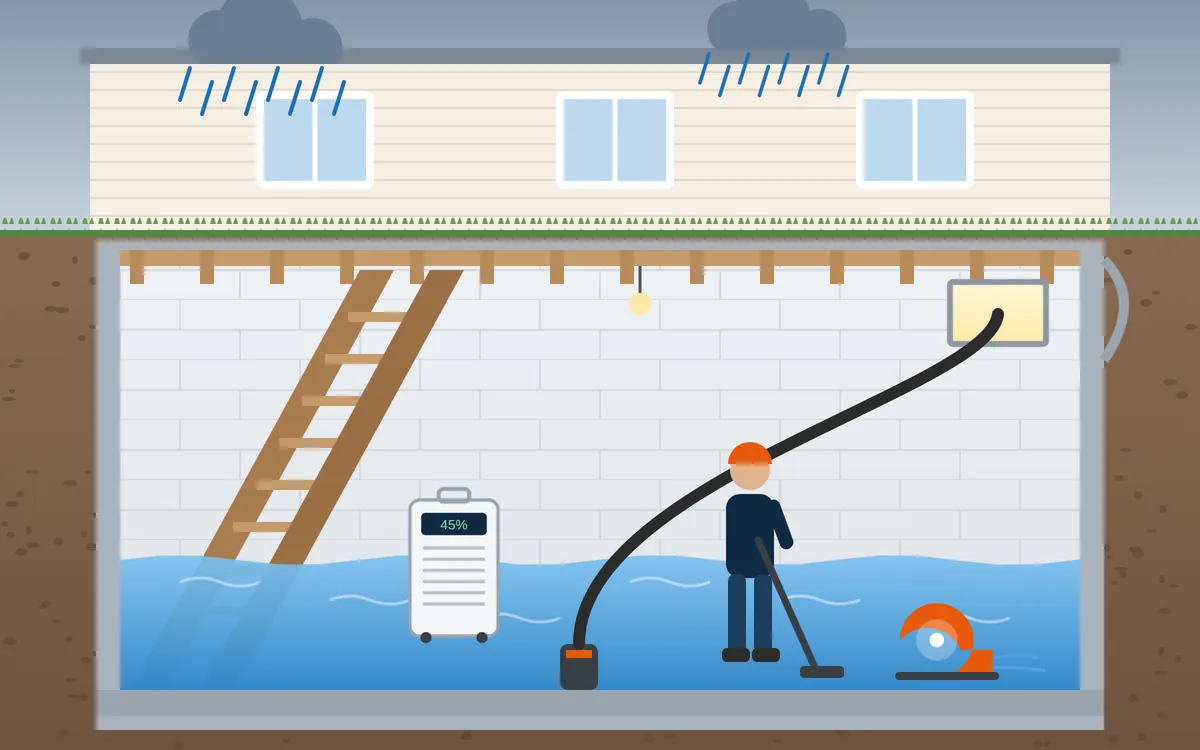
What happens if basement flood cleanup is delayed?
Several things, in a predictable order. In the first 24 hours, water category progresses (clean → gray, gray → black), and more materials become unsalvageable. By 48 hours, mold can begin on susceptible materials — turning a water-damage job into a water-damage plus mold-remediation job. After a week, structural materials like wood framing and subfloor start to deteriorate, and the cost of the full restoration can double or triple compared to immediate response.
What Happens in the First 24 Hours of Delay
The IICRC S500 water damage restoration standard defines three water categories: Category 1 (clean), Category 2 (gray), Category 3 (black). Water category is not static — it changes with time.
- Category 1 water (burst supply pipe, water heater) becomes Category 2 after 24 hours. Bacteria multiply, sediment accumulates, surfaces contaminate.
- Category 2 water becomes Category 3 after 48 hours. The scope expands: more porous materials must be removed, PPE requirements rise, antimicrobial becomes required.
- Carpet pad and drywall below the water line begin absorbing water into inner layers. Earlier removal means less material cost.
Cost impact in the first 24 hours: generally 15-30% higher for Category 2 scope than Category 1.
Hours 24-48: The Mold Window Opens
The EPA's position: "Clean and dry water-damaged areas and items within 24-48 hours to prevent mold growth." Past that window, mold can begin on susceptible materials — paper-faced drywall, carpet pad, wet fiberglass insulation, cardboard, soft upholstered items.
Visible mold doesn't always appear immediately. The growth often happens inside wall cavities, under flooring, or behind baseboards where airflow is limited and moisture is held. A musty smell is often the first evidence.
Cost impact at 48 hours: typically 40-80% higher than immediate response, because:
- More drywall gets removed (higher flood cuts, more replacement)
- Antimicrobial treatment required throughout
- Air scrubbers added to the drying setup
- Possible mold remediation scope added
Days 3-7: Structural Damage Begins
After several days, the moisture that was initially confined to accessible materials migrates:
- Subfloor swelling and delamination. OSB is particularly vulnerable. Plywood holds up better but can delaminate after prolonged wetness.
- Wood framing moisture content stays elevated. Without airflow, framing can stay at 20-25% MC for weeks, well above the mold threshold.
- Metal fasteners corrode. Nail heads, hangers, and metal strapping begin oxidizing.
- Finish materials (hardwood floors, trim, cabinetry) deteriorate past the point of restoration.
- Odors establish. MVOCs (microbial volatile organic compounds) from mold and bacteria get absorbed into surrounding materials and become hard to remove.
At 1 week delay, total restoration cost is typically 2-3× what immediate response would have been.
Beyond One Week: The Scope Transformation
A basement left wet for more than a week is no longer a water-damage job. It is:
- A mold remediation job (likely requiring S520 scope)
- A structural assessment job
- A content loss job (most porous belongings are unsalvageable)
- Potentially an indoor air quality concern for the whole house
Insurance claims for extended delays often face pushback. Most homeowners policies require you to mitigate further damage — not acting on a known water event may give the insurer grounds to reduce or deny coverage for mold or additional structural damage.
Why People Delay (and How to Avoid It)
Common reasons cleanup gets delayed, and what to do instead:
- "I didn't notice it right away." Smart water sensors near the water heater, washing machine, and under sinks catch leaks within minutes. $20-50 each.
- "I was waiting for the insurance adjuster." Don't. Most policies require you to prevent further damage — start mitigation immediately and document everything.
- "I thought it would dry out on its own." Standing water is rarely the problem — it's the water inside walls and under floors that doesn't evaporate without commercial equipment.
- "I couldn't reach a restoration crew." Try the next one. Front Range crews are usually available within hours.
- "The basement was unfinished, I thought it didn't matter." Unfinished basements still have framing, sill plates, stored belongings, and HVAC equipment that can all be damaged.
Colorado-Specific Delay Patterns
Three delay situations come up repeatedly along the Front Range:
- Vacation homes in Summit, Grand, Eagle counties. A burst pipe in a winter cabin may not be discovered until the owner's next weekend trip — often 1-2 weeks later. The cost difference between same-day and 2-week response can be $20,000+ for a finished basement.
- Snowbird homes in the Southwest. Owners traveling in winter may miss weeks of damage. Smart water shutoffs that auto-close during freeze events are worth considering.
- Front Range storm events. During a major Front Range storm, crew availability can stretch 24-48 hours. If you cannot get a professional within that window, start DIY extraction and drying to limit the delay cost.
Why to Call Even After a Delay
Even if cleanup is already delayed, calling a restoration crew is still worth it:
- They can assess current moisture conditions and set a realistic drying plan.
- They can identify what's salvageable before unnecessary demolition.
- They can start mold remediation if growth has already begun.
- They can document the condition for insurance.
- Delayed response doesn't automatically disqualify an insurance claim — but delayed action often does. Starting now limits further damage.
Call (800) 231-6861 for same-day Colorado basement response.
Frequently Asked Questions
How quickly does cost actually increase with delay?
A rough rule of thumb from IICRC data: 15-30% at 24 hours, 40-80% at 48 hours, 100-200% at 1 week. Beyond a week, the scope often transforms from water damage to mold remediation plus structural repair.
Does delayed cleanup void my insurance coverage?
Not automatically, but it can. Most homeowners policies have a 'duty to mitigate' clause. Failing to act on a known water event may give the insurer grounds to reduce coverage for mold or additional damage that resulted from the delay. Starting cleanup is more important than waiting for the adjuster.
I just discovered water that's been sitting for a week — what now?
Call a professional restoration crew that handles mold remediation (IICRC S520 certified). Document everything photographically before any cleanup. Open a claim and document the delay reason (vacation, hidden leak, etc.) — honest explanations often preserve coverage.
Can I DIY delayed cleanup to save money?
For water sitting more than 48 hours, no. The scope has grown beyond what standard DIY equipment handles — likely mold remediation, contaminated material removal, and professional moisture verification. DIY often costs more in the end by missing hidden moisture that continues growing mold.
What about a basement left wet for months?
Mold remediation plus structural assessment are the starting points. An inspector can tell you what's recoverable. In extreme cases, gut-to-studs reconstruction is the only path forward.
Is Colorado's dry air protective against delay damage?
Partially. Outdoor dry air helps basements dry faster once the water is removed. It doesn't protect against the first 24-48 hours when water is still sitting. The delay math is roughly the same in Denver as in Houston for the first 2 days.
Sources and further reading
- EPA: Flooded Home Guidance
- EPA: A Brief Guide to Mold, Moisture and Your Home
- ANSI/IICRC S500 Water Damage Restoration Standard
- Colorado Division of Insurance
These authoritative public sources were used to verify the technical, safety, and insurance information on this page. They are not endorsements of MH Restoration.
Need help with basement flood cleanup in Colorado? Call for 24/7 IICRC-certified response.
Call (800) 231-6861