
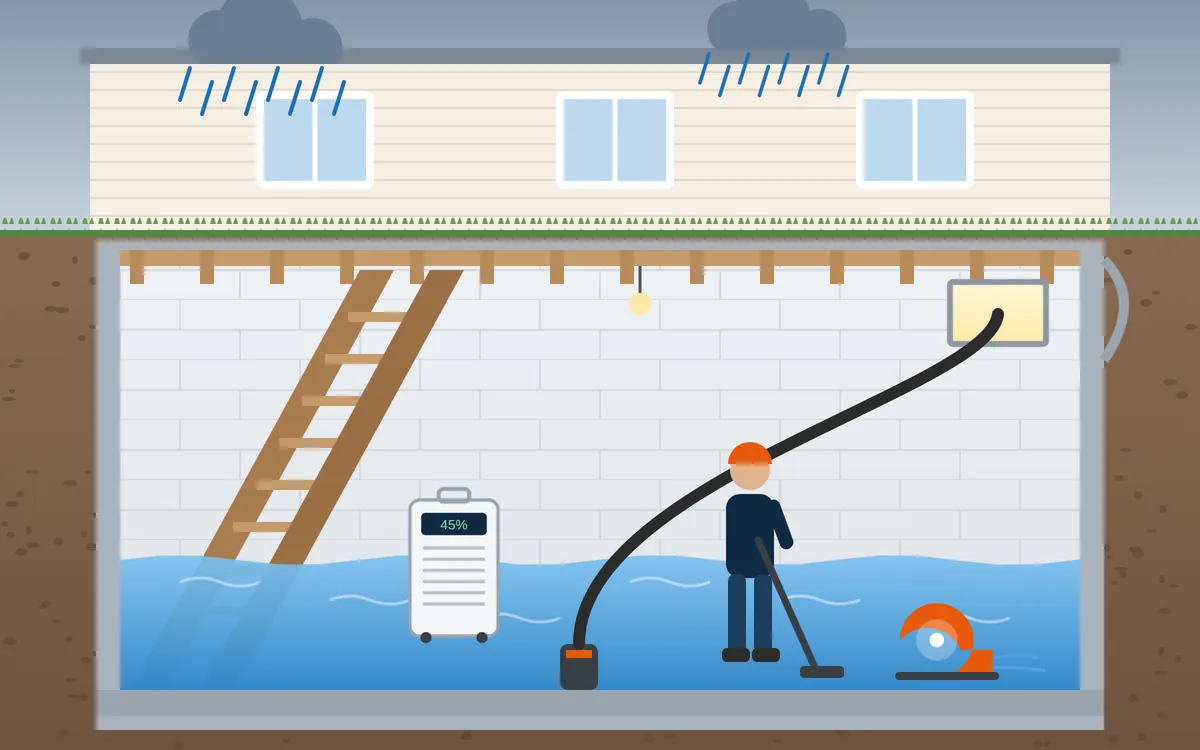
How quickly can mold grow after a basement flood?
The EPA says cleaning and drying wet building materials within 24-48 hours is the key to preventing mold growth. That window is a guideline, not a precise clock — actual mold growth depends on the material, temperature, humidity, and whether the material was contaminated. Some susceptible materials (wet paper-faced drywall, soaked carpet pad) can show visible mold within 2-3 days in warm conditions; others take longer. The practical rule: if drying takes more than 48 hours, assume mold mitigation may be needed.
What the EPA Actually Says About the 24-48 Hour Window
The EPA's position is consistent across its mold and flood publications: "The key to mold control is moisture control. Clean and dry water-damaged areas and items within 24-48 hours to prevent mold growth."
Three important qualifications on that number:
- It's a prevention guideline, not a growth guarantee. Mold spores are everywhere in the air; what they need is moisture, food (paper, wood, dust), and time. The 24-48 hour window is when conditions become increasingly favorable for growth, not when growth suddenly begins.
- It depends on the material and conditions. Paper-faced drywall soaked with clean water in a 75°F basement can show visible mold in 2-3 days. Concrete flooded for the same duration rarely does. Fiberglass insulation can harbor mold for weeks without visible signs.
- It assumes the materials can actually be dried in that window. If a wall cavity is saturated and drying crews don't arrive until day 3, the window is already closed on those materials.
The practical upshot: faster is better, but passing the 48-hour mark does not automatically mean every material grows mold. It means you should assume mold risk and verify.
Which Basement Materials Are Most Vulnerable
| Material | Mold risk | Why |
|---|---|---|
| Paper-faced drywall | Very high | The paper facing is food for mold. Gypsum core retains moisture. |
| Carpet pad | Very high | Holds water like a sponge. Dark, warm, wet — ideal mold conditions. |
| Fiberglass insulation | High | Traps moisture inside wall cavities. Difficult to dry in place. |
| Cellulose insulation | Very high | Paper-based. Retains moisture for weeks. |
| Carpet (face fiber) | Moderate | Synthetic fibers themselves don't support mold; backing and dust accumulated in the carpet can. |
| Wood framing | Moderate | Supports mold if it stays wet. Dries fast with airflow. |
| Subfloor (plywood, OSB) | Moderate-high | OSB is more mold-prone than plywood due to wood chips and adhesives. |
| Concrete | Low | Doesn't feed mold. Organic contaminants on its surface (soap residue, dust) can. |
| Ceramic tile | Low | Mold grows only in grout lines or at edges if organic matter is present. |
| Metal, glass, plastic | Very low | No food source. Surface mold (from dust) washes off. |
What Mold Prevention Actually Looks Like
Mold prevention after a basement flood is not spraying bleach — it's removing the conditions mold needs. Four elements:
- 1
Remove the standing water fast
Within the first few hours. See our guide on how to remove basement water.
- 2
Remove unsalvageable porous materials
Carpet pad, wet fiberglass, drywall below the flood cut. These dry slowly inside walls and keep providing moisture to the air.
- 3
Run commercial drying for several days
Axial air movers and a low-grain refrigerant dehumidifier. Keep running continuously until moisture meters confirm the materials are dry.
- 4
Apply an EPA-registered antimicrobial to affected surfaces
Only after cleaning. Antimicrobial does not replace drying — it treats surfaces for residual spores after the moisture source is gone.
If Mold Has Already Started
The EPA generally distinguishes between smaller mold patches that homeowners can address and larger growth that typically requires professional remediation. The EPA often uses "greater than 10 square feet" as a general threshold where professional mold remediation becomes appropriate; smaller patches on hard non-porous surfaces may be handled with cleaning and drying.
Signs mold has started after a flood:
- Musty smell that didn't exist before the flood
- Visible discoloration at the baseboard line or on drywall
- Dark spots on wood framing
- Soft, powdery areas on ceiling tile or wallpaper
- Respiratory symptoms (coughing, sneezing, headaches) that appear while in the basement
Any of these warrant investigation. Our scope at MH Restoration focuses on water damage cleanup and prevention; for mold remediation specifically, work with a mold-remediation professional experienced with the EPA guidelines.
Colorado-Specific Mold Conditions
Colorado's dry climate is often described as mold-resistant. That's half true:
- In open indoor air, low outdoor humidity (typically 20-40% in Colorado) helps keep basements drier than more humid regions.
- Inside wall cavities and under flooring, trapped moisture behaves the same as anywhere else. The outdoor humidity of Denver doesn't reach inside a wet wall.
- In finished basements, which are now common across Front Range new construction, moisture that gets behind drywall has the same mold risk as in any climate.
Boulder County post-flood guidance (from the 2013 floods) documents mold as a recovery concern across the Front Range. The EPA's flooded-home guidance applies to Colorado as much as any other state.
What to Do with HVAC After a Flooded Basement
If a furnace, air handler, or ductwork was affected by flood water, do not operate it until an HVAC technician has inspected it. Running a flood-affected HVAC system can distribute mold spores and contaminants throughout the house. Change the furnace filter after any basement cleanup; consider a HEPA filter during active drying to reduce airborne particles.
Frequently Asked Questions
Will mold definitely grow if cleanup takes more than 48 hours?
Not definitely, but the risk rises significantly. The EPA frames 24-48 hours as the window for preventing growth, which means materials still wet past 48 hours are at elevated risk. The actual outcome depends on material type, temperature, and humidity.
Can I kill mold with bleach after a basement flood?
Bleach can kill surface mold on hard non-porous surfaces like concrete or tile. It does not reliably kill mold inside porous materials like drywall or wood framing. EPA-registered antimicrobials are more effective and don't off-gas chlorine. Addressing moisture is far more important than killing visible mold.
How can I tell if there's mold inside my walls after flooding?
A musty smell that comes and goes is the earliest sign. Visible discoloration at the baseboard line, wall cavity moisture readings that stay elevated past drying time, or respiratory symptoms in the basement all suggest investigation. A mold inspector can sample air and surfaces to confirm.
Do I have to replace all the drywall that got wet?
Not all — only drywall below the flood cut line (typically 12-24 inches above the water line). Drywall above the wick line usually stays if the back of the wall cavity is dried. See our material recovery guide for details.
Is Colorado's dry climate enough to prevent basement mold?
No. Outdoor dry air helps open spaces and dehumidifier efficiency, but it doesn't reach inside wet wall cavities or under flooring. Finished Colorado basements have the same mold risk as finished basements in any climate.
Should I buy a mold test kit?
Home mold test kits have limited diagnostic value. A better investment is a pin-type moisture meter ($30-80), which tells you whether moisture is still present — the actual condition that drives mold. If you're concerned about active mold, hire a mold inspector who collects samples for a lab.
Sources and further reading
- EPA: A Brief Guide to Mold, Moisture and Your Home
- EPA: Flooded Home Cleanup Guidance
- EPA: Flood Cleanup to Protect Indoor Air Quality
- CDC: Mold After a Disaster
- ANSI/IICRC S520 Mold Remediation Standard
These authoritative public sources were used to verify the technical, safety, and insurance information on this page. They are not endorsements of MH Restoration.
Need help with basement flood cleanup in Colorado? Call for 24/7 IICRC-certified response.
Call (800) 231-6861