
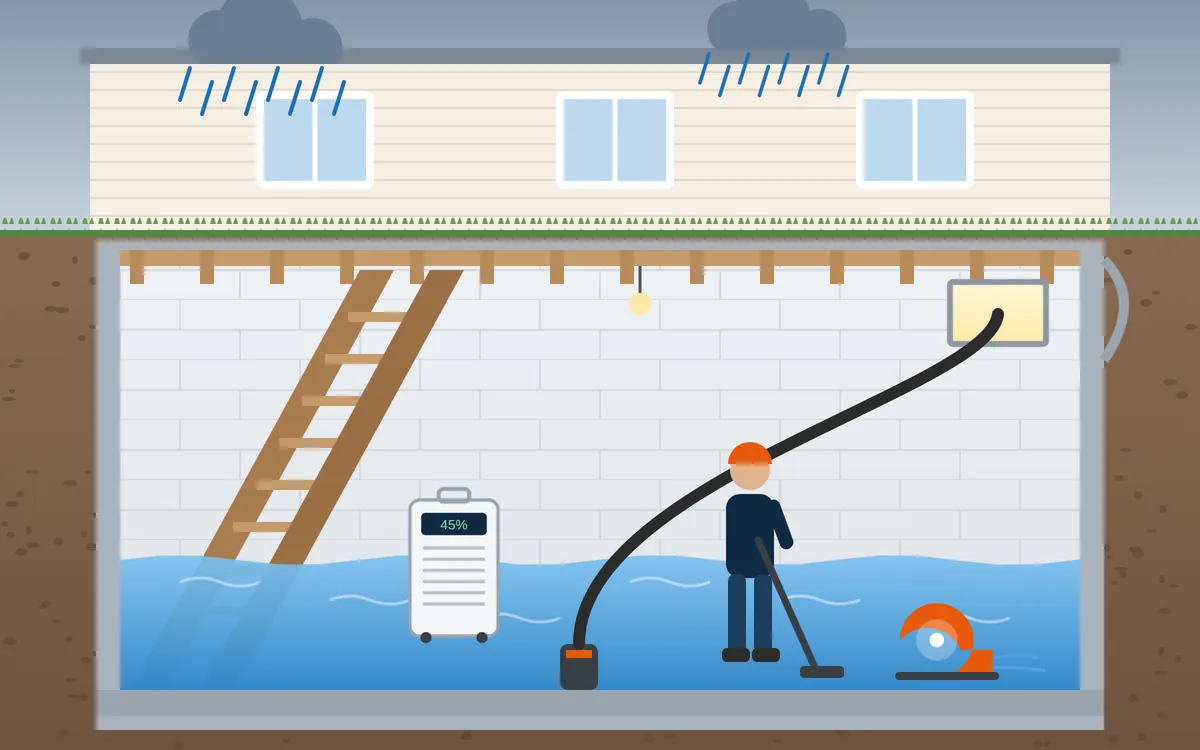
How can I tell if my basement is actually dry after flooding?
You cannot tell by looking or touching. The concrete slab, drywall, and framing can feel dry on the surface while still holding significant moisture inside. A basement is verified dry when a pin-type moisture meter on affected materials reads within the same range as a dry reference reading from unaffected material elsewhere in the home, for two consecutive daily checks. This is the completion standard in the ANSI/IICRC S500 water damage restoration standard.
Why Appearance and Humidity Don't Prove a Basement Is Dry
Three things mislead homeowners into closing up a basement too early:
- Surface drying. The top layer of a concrete slab or the face of a drywall panel dries first. What's inside (the 2-4 inches of concrete below the surface, the gypsum core of the drywall) can still be wet.
- Room humidity dropping. A low humidity reading means the air is dry — it doesn't mean the materials in the room are dry. Materials release moisture slowly into dry air.
- Touch test. A wall at 20% moisture content feels identical to a wall at 8% moisture content. Hands cannot detect the difference that matters for mold prevention.
The ANSI/IICRC S500 standard — the professional restoration standard — requires instrument readings, not visual or tactile checks, to declare materials dry.
The Three Instruments That Actually Measure Dryness
Pin-type moisture meter
Two metal pins penetrate the material and measure electrical resistance. Lower resistance = more moisture. Reads in percent moisture content (%MC) for wood, or on a 0-100 relative scale for drywall. Accurate but makes two small holes per reading.
What to look for: Wood framing under 15% MC. Drywall readings in the "dry" range (varies by meter — read the scale that came with it).
Pinless (non-penetrating) moisture meter
Uses radio frequency to measure moisture to about 1 inch deep without touching. Non-destructive. Good for scanning a floor or wall quickly to find wet pockets.
What to look for: Readings at affected areas within 5% of a known-dry reference reading from the same material elsewhere.
Thermohygrometer
Measures air temperature, relative humidity, and dew point. Used to evaluate drying conditions, not to declare materials dry. Essential for professional drying but informational for homeowners.
The Dry Reference Reading: The Step Most Guides Miss
A moisture meter reading means very little on its own. "18% moisture content" could be wet or normal depending on the material. What matters is how the affected area compares to unaffected material of the same type elsewhere in the house.
Example: If a dry section of your drywall (upstairs, unaffected) reads 8 on your meter, then the wet section is "dry" when it also reads 8 — not when it reads some universal number.
Take reference readings at:
- Dry drywall in an upstairs room
- Dry wood framing (a stud in a dry closet)
- Dry concrete (a slab in an unaffected area, if available)
- Dry carpet in a different room
Write these down. They become your target.
What a Drying Log Looks Like
A professional restoration crew keeps a daily drying log for every job. Insurance companies expect to see one. Here's the format:
| Date | Location | Material | Reading | Dry target | Dry? |
|---|---|---|---|---|---|
| Day 1 | North wall, 6" from floor | Drywall | 45 | 8 | No |
| Day 2 | North wall, 6" from floor | Drywall | 32 | 8 | No |
| Day 3 | North wall, 6" from floor | Drywall | 18 | 8 | No |
| Day 5 | North wall, 6" from floor | Drywall | 9 | 8 | No (trend good) |
| Day 6 | North wall, 6" from floor | Drywall | 8 | 8 | Match #1 |
| Day 7 | North wall, 6" from floor | Drywall | 8 | 8 | Match #2 — DRY |
Two consecutive matching readings is the standard. One match could be a meter fluctuation; two in a row confirms the material has stabilized.
Keep readings at a grid pattern — don't rely on one spot. A typical 1,000 sq ft wet basement might have 12-20 monitoring points.
Thermal Cameras: What They Do and Don't Prove
Wet materials are cooler than dry materials because evaporation pulls heat out. Thermal cameras show this as a darker (colder) area on screen. They're useful for finding wet spots to investigate.
But a thermal camera does not prove water is present — a cold spot could be an air leak, a cold plumbing pipe, or an insulation gap. Professional drying crews use thermal images to locate suspect areas, then confirm with a pin meter.
Why Colorado's Dry Climate Does Not Shortcut This
A common mistake Colorado homeowners make: "the air here is so dry, my basement will dry fast." That's partly true — low outdoor humidity helps dehumidifiers work efficiently. But it does not mean the materials dry faster than the moisture content of unaffected reference material.
A Fort Collins basement at 5,000 feet still needs instrument-verified drying. The drying process is identical to drying a basement in any other climate. Elevation changes evaporation rates slightly; it does not change what "dry" means.
When Drying Equipment Can Be Removed
- All monitored materials match their dry reference readings.
- Two consecutive daily readings confirm the match (no fluctuation).
- Every grid point has been measured — not just the easily accessible ones.
- Hidden areas (behind baseboard, inside wall cavities if accessible) have been checked.
- The ambient room humidity has stabilized in a normal range (30-50%).
Only then should air movers and the dehumidifier be removed and reconstruction begin.
Frequently Asked Questions
Can I just use a cheap moisture meter from the hardware store?
Yes, with limits. A $30 pin meter will tell you relative wet/dry comparisons accurately. It may not calibrate across different materials. Use it to compare affected spots against a known-dry reference spot, which is what matters most.
How often should I take moisture readings?
Daily during active drying. Same spots each time. Record the numbers and the date. Professional restoration crews do this for insurance documentation; it's equally useful for DIY.
What's the dry standard for drywall after flooding?
Match a dry reference reading from unaffected drywall elsewhere in your home. On most non-penetrating meters, dry drywall reads between 0.3 and 1.0 (varies by meter). Don't rely on a universal number — compare to your own home's unaffected material.
Does concrete ever actually dry after flooding?
Yes, but slowly. The top surface dries in days; the slab's full moisture content can take weeks. A non-penetrating meter on the slab surface, compared to a dry reference slab, is the practical check. For critical applications (installing moisture-sensitive flooring), use calcium chloride testing or in-situ RH probes.
Can I close the walls back up if the drywall reads dry but the framing hasn't been checked?
No. Framing behind wet drywall holds moisture that will transfer back into any new drywall closed over it. Check framing with a pin meter on exposed studs, or wait until the wall cavity has been open to room air long enough for both to dry.
How long does drying typically take in a Colorado basement?
3 to 7 days for clean water in an unfinished basement. 5 to 10 days for a finished basement with drywall and carpet. 7 to 14 days for Category 2 or 3 water. Verified by instrument readings, not by elapsed time.
Sources and further reading
- ANSI/IICRC S500 Water Damage Restoration Standard
- EPA: Flood Cleanup to Protect Indoor Air Quality
- EPA: A Brief Guide to Mold, Moisture and Your Home
These authoritative public sources were used to verify the technical, safety, and insurance information on this page. They are not endorsements of MH Restoration.
Need help with basement flood cleanup in Colorado? Call for 24/7 IICRC-certified response.
Call (800) 231-6861