
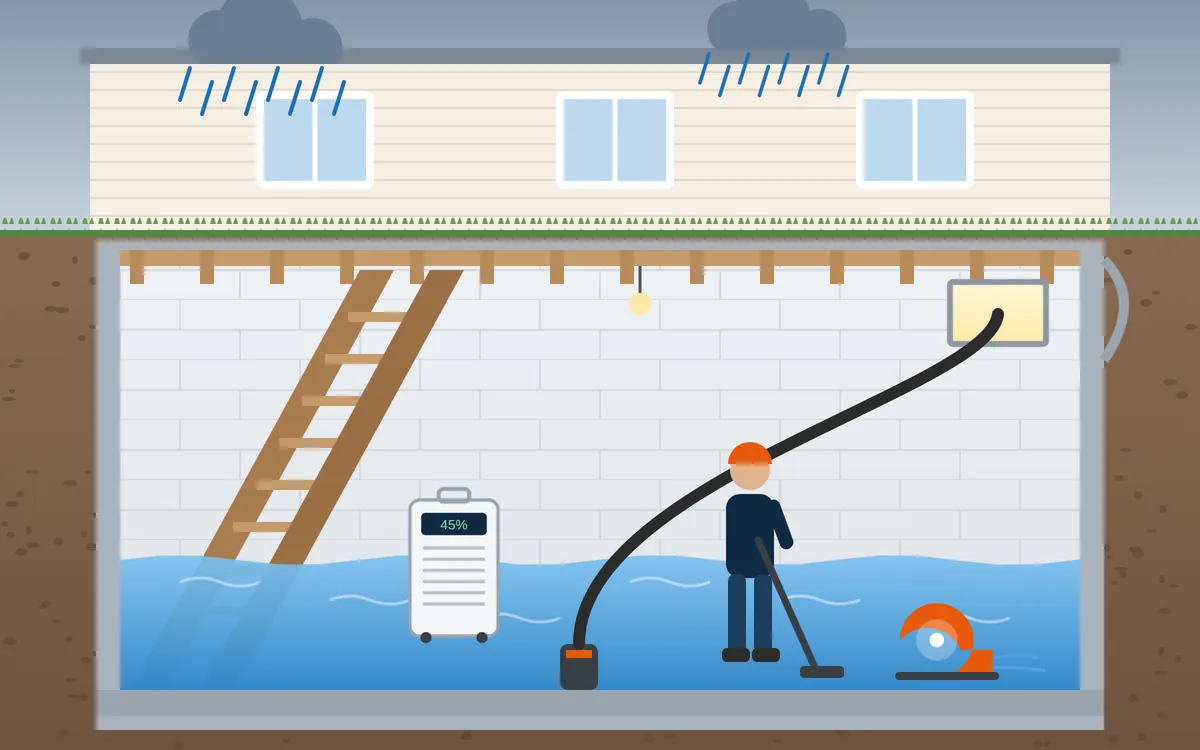
Interior or exterior drainage: which actually stops basement flooding?
Neither is universally better. The right choice depends on where water is entering: exterior drainage addresses water before it reaches the foundation, interior drainage collects water once it's already inside. Exterior solutions are more disruptive and expensive but address root causes. Interior solutions are less disruptive and cheaper but manage water rather than preventing it. The best approach for most recurring Colorado flooding problems is to first fix surface drainage (grading, gutters, downspouts), then evaluate whether interior or exterior subsurface drainage is needed.
Before Any Drainage Installation: Fix the Cheap Stuff First
The University of Minnesota Extension and most building-science sources recommend addressing surface drainage before considering interior or exterior drainage systems. In many cases, the cheap fixes solve the problem entirely:
- 1
Extend downspouts 6+ feet from the foundation
$30-100 per downspout. The highest-ROI basement flood prevention step. A single rainfall of 1 inch on a 2,000 sq ft roof produces approximately 1,250 gallons of water — dumping it next to the foundation is a direct cause of basement flooding.
- 2
Regrade soil to slope away from the house
$500-3,000 depending on scope. The first 10 feet of soil around the foundation should slope away at about 1 inch per foot (6 inches over 6 feet is a common target).
- 3
Install window well covers with drains
$100-400 per well. Prevents window wells from filling during summer storms and dumping water onto the basement floor.
- 4
Clean and repair gutters
Overflowing gutters drop concentrated water at the foundation. Twice-yearly cleaning is standard.
Do these four first. For many Colorado basements, especially in neighborhoods with original 1970s-80s grading that's settled, these fixes resolve the recurring flooding.
Exterior Basement Drainage
What it is
A system that intercepts water outside the foundation and redirects it away before it reaches the wall. Typical components:
- Footing drain (drain tile): Perforated pipe at the base of the foundation footing, in gravel, wrapped in filter fabric. Collects groundwater and routes it to daylight or a sump.
- Exterior waterproofing membrane: Rubber or polymer sheet applied to the foundation wall exterior. Prevents water from penetrating the concrete.
- Drainage board or dimple mat: Channels water down the foundation wall to the footing drain instead of against the wall.
- Clean backfill: Permeable soil (gravel) around the foundation, replacing clay that holds water.
Cost range (Colorado, 2026)
$15,000-$50,000+ depending on home size, soil conditions, and landscaping that needs to be replaced. For a typical 2,000 sq ft home needing full perimeter work, $25,000-$35,000 is common.
What it addresses
- Groundwater pressure against foundation walls
- Water entering through wall-floor joints (cove joint)
- Water penetrating porous masonry walls
- Seepage through foundation cracks
What it does not address
- Water entering from above (window wells, gutters, roof)
- Plumbing leaks
- Sewer backups
- Sump pump failures
Disruption
High. Requires excavating the full perimeter of the foundation to its base. Landscaping, driveways, patios, and sidewalks adjacent to the foundation typically need to be removed and reinstalled.
Interior Basement Drainage
What it is
A system installed inside the basement that collects water once it enters and routes it to a sump pit for pumping out. Typical components:
- Interior perimeter drain: Perforated pipe installed in a channel cut into the basement floor at the wall-floor joint. Collects water that comes through the cove joint.
- Sump basin and pump: Receives the collected water and discharges it outside.
- Vapor barrier on walls: Plastic sheeting that directs wall seepage down to the perimeter drain.
- Battery backup sump: Secondary pump for power outages (highly recommended in Colorado).
Cost range (Colorado, 2026)
$5,000-$15,000 for a typical system. Much more affordable than exterior; part of why it's more common.
What it addresses
- Groundwater seeping in through the wall-floor joint
- Water collecting on the basement floor from various sources
- Rising water table during spring runoff
What it does not address
- Water entering above the floor (through walls, windows, upper foundation)
- The outside pressure causing the water intrusion
- Deteriorating foundation walls that continue to let water through
- Plumbing or sewer events
Disruption
Moderate. Basement floor is cut along the perimeter (12-18 inches wide trench). Finished walls and flooring need to be opened at the perimeter. Work typically completes in 2-5 days.
Direct Comparison
| Exterior | Interior | |
|---|---|---|
| Cost (typical home) | $25,000-35,000 | $5,000-15,000 |
| Disruption | High (excavation) | Moderate (floor cut) |
| Addresses root cause | Yes | No (manages symptom) |
| Addresses wall seepage | Yes | Partial |
| Addresses window wells | No | No |
| Addresses plumbing leaks | No | No |
| Addresses sewer backup | No | No |
| Requires sump pump | Often yes | Yes |
| Lifespan | 20-30+ years | 15-25 years |
| Can be done on finished basement | Yes (exterior work) | Yes (with interior demo) |
Which to Choose Based on Water Source
Match the solution to the actual water source:
| Where water enters | Appropriate solution |
|---|---|
| Through window wells during storms | Window well covers + drains (not interior/exterior drainage) |
| Along the wall-floor joint during spring runoff | Interior perimeter drain + sump |
| Through visible cracks in foundation wall | Crack repair; exterior waterproofing if recurring |
| Through porous foundation walls (seepage over whole wall) | Exterior waterproofing membrane |
| Up through floor drains (sewer backup) | Backwater valve + plumbing assessment |
| Around utility penetrations | Seal penetrations; address grading above |
| Everywhere, consistent high water table | Both interior and exterior; consult foundation engineer |
This is why source diagnosis matters before solution selection. Installing a $30,000 exterior drainage system for a problem actually caused by a $400 downspout fix is a recurring story in basement waterproofing.
Colorado-Specific Considerations
- Expansive clay soils along the Front Range (documented by the Colorado Geological Survey) cycle through swell and shrink seasons. This stresses exterior drainage installations and can create new cracks over time.
- Freeze-thaw cycles at higher elevations stress both systems. Interior systems with sump discharge lines running outside need careful freeze-protection.
- High water tables in spring (common in the San Luis Valley and along Front Range creek corridors) may warrant interior drainage even in homes with excellent exterior grading.
- Burn scar soils (downstream of Waldo Canyon, Marshall Fire, Spring Fire burn areas) have reduced absorption capacity for years after the fire, which can make surface drainage fixes insufficient.
What MH Restoration Does (and Doesn't)
To be clear on scope: our Colorado team handles basement flood cleanup and water damage restoration services — extraction, structural drying, demolition, sanitization, contents cleaning, and reconstruction after water damage. We do not install drainage systems or do foundation waterproofing.
What we can help with:
- Clean up basement flood damage after it happens
- Diagnose water source as part of restoration (what we see during cleanup often reveals the root cause)
- Recommend when a drainage specialist is worth consulting
- Coordinate with your drainage contractor if restoration happens before or after their work
For drainage installation itself, look for a foundation specialist or waterproofing contractor with Colorado-specific experience. Get at least two estimates; the proposals often differ substantially.
Frequently Asked Questions
If I had to choose one, which is better — interior or exterior?
There's no universal answer. Exterior addresses root causes but costs 3-5× more and is highly disruptive. Interior manages the symptom affordably but doesn't stop water from reaching the foundation. For most Colorado homes, surface drainage fixes (downspouts, grading) should be tried first — they often resolve the problem for a few hundred dollars.
Can I install interior drainage myself?
Technically yes with significant concrete work and experience; practically no. Mistakes in the slope, filter fabric, or sump discharge cause problems that are expensive to correct. Interior drainage is typically installed by specialty contractors with proper equipment for floor cutting and concrete work.
Does interior drainage prevent future basement flooding completely?
No. It manages water that enters through the wall-floor joint. It does not stop water from entering through window wells, upper walls, plumbing, or sewers. The sump pump that powers it can also fail, which is why battery backup is important.
Does homeowners insurance cover drainage installation?
Rarely. Drainage installation is considered a home improvement, not insurance-covered damage repair. Some policies may partially cover installation that's part of a covered loss repair, but usually drainage is out-of-pocket.
What about combined interior and exterior drainage?
Occasionally recommended for homes with severe recurring flooding from multiple sources. Typical in the Front Range for homes near creek corridors with high water tables. Cost combines both systems, usually $40,000-$75,000.
Do sump pumps require regular maintenance?
Yes. Test quarterly with a 5-gallon bucket of water. Replace the primary pump every 7-10 years. Check the battery backup annually. Keep the sump pit clear of debris.
Sources and further reading
- University of Minnesota Extension: Moisture in Basements
- Colorado Geological Survey: Expansive Soils
- National Association of Home Builders: Building Moisture Guidance
- ANSI/IICRC S500 Water Damage Restoration Standard
These authoritative public sources were used to verify the technical, safety, and insurance information on this page. They are not endorsements of MH Restoration.
Need help with basement flood cleanup in Colorado? Call for 24/7 IICRC-certified response.
Call (800) 231-6861