

Who do I call for basement flood cleanup in Allenspark, CO?
Call (800) 231-6861 to be connected with an IICRC-certified basement flood cleanup crew serving Allenspark (1 approved ZIP code). Before you call: shut off power to the basement from a dry location, stop the water source if you can, take photos for your insurance claim, and keep children and pets away from standing water.
What to Do Right Now if Your Allenspark Basement Is Flooding
Every hour a Allenspark basement sits in standing water, the mold clock ticks closer to 24-48 hours — the window the EPA cites for microbial growth to begin. If water is still rising, these are the first steps, in order:
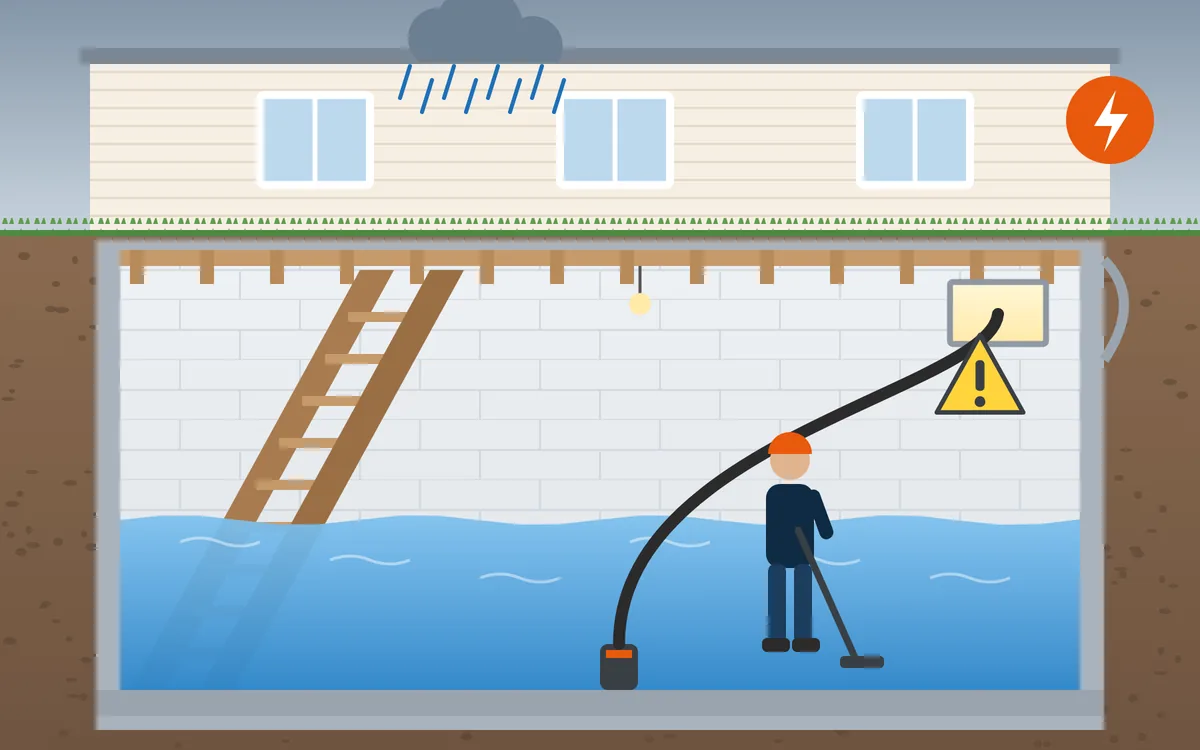
- Stay out of standing water until basement power is off at a breaker you can reach from a dry location. Water and electricity cause more injuries than flooding itself.
- Stop the water source if you can: close the house main water valve for a plumbing leak, check the sump pump breaker and float, or stop using water in the house if a floor drain is backing up.
- If water smells of sewage or appears dark, treat it as Category 3 — keep children and pets out, wear PPE, and call a certified crew. Do not wade in without protection.
- Photograph everything — wide shots of each wall, close-ups of the water line, damaged items, and the water source. Photos with timestamps are what win insurance claims later.
- Call (800) 231-6861 to be connected with a basement flood cleanup crew serving Allenspark, CO. Describe the water color, how deep it is, and whether you know the source.
Basement Flooding in Allenspark, CO: Local Conditions and Risk Patterns
Allenspark sits in Boulder County at approximately 8,451 feet of elevation in the Boulder/Foothills region, with its drainage shaped by Rock Creek and the North St. Vrain.
Allenspark's housing stock includes university-area rental homes, historic downtown brick buildings, mountain cabins, and newer foothills subdivisions with daylight basements. That mix matters for flooded basement cleanup in Allenspark, because older and newer homes fail in different ways. Older homes often have clay or cast-iron sewer laterals that can crack, root-invade, or back up during heavy storms, which is a common setup for a basement sewage backup. Newer homes typically have finished basements with drywall, carpet pad, and insulation that hide water above the baseboard, making professional moisture monitoring essential.
The climate here is a semi-arid foothills climate with heavy winter snow, intense summer monsoon storms, and major wildfire exposure. Boulder and the Front Range foothills sit at the base of the Rockies in a geometry that funnels storm runoff into narrow drainages. The September 2013 floods were catastrophic here, with Boulder, Lefthand, and St. Vrain Creeks all producing record flows and widespread basement flooding across Boulder County. The December 2021 Marshall Fire burned through Louisville, Superior, and unincorporated Boulder County, and the resulting burn scar has changed how summer storms behave in those neighborhoods. Winter cold snaps affect the whole Front Range, but foothills elevations amplify the cold.
ZIP Codes We Serve in Allenspark, CO
Our approved Allenspark basement flood cleanup coverage in Allenspark, Colorado includes the following ZIP code:
- 80510
If you need basement water removal in Allenspark but your Allenspark ZIP code is not listed above, call (800) 231-6861 and we'll tell you honestly whether we can help from our nearest crew.
Most Common Causes of Flooded Basements in Allenspark
Based on claim patterns in Boulder/Foothills and the housing stock typical of Allenspark, these are the causes of basement flooding we see most often:
- 1
Flash flooding from Front Range thunderstorms
Concentrated in the boulder, lefthand, and st. vrain watersheds.
- 2
Burn scar flooding
From the marshall fire and ncar fire burn areas.
- 3
Snowmelt
Driving foothills creek flows in may and june.
- 4
Burst pipes
During foothills cold snaps.
- 5
Sewer backups
In older boulder neighborhoods.
For a detailed breakdown of each cause and how to prevent it, see our Colorado basement flooding causes guide.
Basement Water Removal & Water Damage Restoration in Allenspark
Allenspark homeowners need different services depending on the water category and the finished materials involved. Flooded basement cleanup allenspark usually starts with basement water removal in Allenspark, followed by structural drying and, where needed, basement water damage cleanup Allenspark. Our Allenspark crews handle every stage:
24/7 Emergency Basement Flood Cleanup
Same-day response for Allenspark homeowners dealing with active flooding.
Learn more →
Basement Water Removal, Extraction & Pump-Out
Truck-mounted extractors sized for Allenspark basement flood volumes.
Learn more →
Basement Structural Drying & Dehumidification
Commercial LGR dehumidifiers and axial air movers for Allenspark basements.
Learn more →
Sewage Backup & Contaminated Water Cleanup
IICRC-certified Category 3 water cleanup for Allenspark sewer backups.
Learn more →Other basement flood cleanup services in Allenspark
- Basement Flood Damage Cleanup & Restoration
- Basement Stormwater & Groundwater Flood Cleanup
- Basement Sump Pump Failure Cleanup
- Basement Burst Pipe Water Cleanup
- Basement Appliance Overflow Cleanup
- Finished & Unfinished Basement Flood Cleanup
- Basement Carpet Water Extraction & Drying
- Basement Floor, Wall & Drywall Water Damage
- Basement Subfloor Drying & Moisture Removal
- Flood Sanitization, Disinfection & Odor Removal
- Debris Removal, Contents Cleaning & Reconstruction
Water in your Allenspark basement right now? Call for basement water removal in Allenspark and talk to an IICRC-certified local crew.
Call (800) 231-6861How Flooded Basement Cleanup in Allenspark Works, Step by Step
Professional Allenspark basement flood cleanup follows the IICRC S500 water damage restoration standard — the same process insurance adjusters expect to see on the scope of work. Here is what happens from the first call to the last paint touch-up:
- 1
Call and describe the water in your Allenspark basement
Where it's coming from, how deep, and whether it could be sewage. That sets the response plan and the equipment the crew brings.
- 2
Safety check and source containment
Power, gas, and the water source are confirmed off before anyone works in the water. For sewage, plastic containment goes up to protect the rest of the house.
- 3
Water extraction with commercial equipment
Truck-mounted extractors, submersible pumps, and weighted carpet tools pull standing water and water trapped in pad, concrete, and framing. Basement water removal in Allenspark usually finishes same-day.
- 4
Selective demolition and material removal
Flood cuts in drywall 12-24 inches above the water line, wet insulation removed, carpet pad out, and any Category 3-contaminated carpet removed to meet IICRC S500 standards.
- 5
Structural drying with daily monitoring
Axial air movers and LGR dehumidifiers run continuously with daily moisture meter readings until materials match a dry reference. See our drying guide.
- 6
Verification and reconstruction
Final moisture map confirms dryness, then new insulation, drywall, flooring, trim, and paint complete the water damage restoration in Allenspark.
For the full process, costs, and insurance details, see our professional cleanup process guide.
What Allenspark Homeowners Tell Us Is Hardest About a Flooded Basement
These are the real pain points Allenspark homeowners describe when they call for help — the issues worth preparing for before the water arrives:
- Marshall Fire burn-scar coverage disputes.
- Finding crews during a Boulder County-wide storm event.
- Older Boulder homes with original 1900s plumbing.
- University-area rental coordination with absentee landlords.
- Mountain homes with chronic groundwater and sump issues.
See our how to choose a cleanup company guide for the checklist that addresses most of these.
Seasonal Basement Flooding Risks in and Around Allenspark
Across the Boulder/Foothills region, basement flooding follows a predictable seasonal rhythm that Allenspark homeowners should plan around.
Winter: Burst pipe water and Cold-Snap Pipe Failures
From December through February, Allenspark sees periodic deep freezes that split water lines along exterior walls and in unheated corners. Many burst pipe floods don't appear until the thaw, when ice in the split pipe melts and water starts flowing. See our frozen pipe burst guide.
Spring: Snowmelt, Spring Runoff, and Rising Groundwater
March through May in the Boulder/Foothills region combines snowmelt from nearby mountains with saturated ground that cannot absorb more water. Allenspark basements can see pressure against foundation walls even without visible surface flooding. See our snowmelt flooding guide.
Summer: Thunderstorms, Sump pump failure cleanupIssues, and Hail
Late May through September is the peak monsoon storm season. Allenspark homeowners see sump pump failure cleanup most often during these storms, when the pit inflow exceeds pump capacity or when a storm-related power loss hits during a cell dropping an inch of rain in 30 minutes.
Fall: Sewer backup cleanup and Preparation
Autumn is when older sewer laterals in Allenspark fail — tree roots that grew through summer find their way into clay pipe seams, and backups become common before freeze-up. See our sewer backup guide.
Insurance and Local Resources for Allenspark Homeowners
Insurance coverage for a flooded basement in Allenspark depends entirely on where the water came from. The Colorado Division of Insurance publishes a clear breakdown: standard homeowners policies cover sudden plumbing damage, water-backup endorsements cover sewer and sump backups, and NFIP flood insurance covers water that entered from outside.
- For a sewer backup, contact your Allenspark or Boulder County utilities department to report it and ask whether a city main is involved.
- For a plumbing burst, open a homeowners claim and start mitigation immediately; most policies require you to prevent further damage.
- For groundwater or outside flooding, your NFIP flood insurance is what applies — homeowners insurance will usually deny.
- For gas smells, leave the house and call your utility from outside.
- Document everything before cleanup starts, and keep every receipt and the cleanup crew's moisture logs.
Local resources for Allenspark residents:
- Colorado Division of Insurance
- National Weather Service, Boulder office
- Boulder County Office of Disaster Management
For a detailed insurance walkthrough, see our basement flood insurance claim guide and does homeowners insurance cover basement flooding.
How Allenspark Homeowners Can Prevent the Next Basement Flood
Most basement floods in Allenspark are preventable with a few specific improvements. These are the highest-impact prevention steps for the Boulder/Foothills region:
- Battery-backup sump pump. Covers the storm-related power outages that cause so many sump pump failure cleanup events in Allenspark.
- Downspout extensions 6+ feet from the foundation. Cheapest, highest-ROI prevention for Colorado homes.
- Regrade around the foundation. First 10 feet should slope away from the house.
- Water-backup insurance endorsement. $50-$250/yr for $5,000-$25,000 coverage of sewer and sump events.
- Backwater valve on the sewer lateral. Essential for older Allenspark neighborhoods with aging sewer infrastructure.
- Insulate pipes along exterior walls. Critical in Allenspark given Boulder/Foothills winter temperature swings.
- Window well covers with drains. Keeps summer storm water out of basements.
See our full basement flood prevention checklist.
Basement Flood Cleanup in Allenspark: FAQs
Which ZIP codes do you serve for basement flood cleanup in Allenspark?
Our approved coverage for Allenspark includes ZIP codes 80510. Call (800) 231-6861 to confirm service at your exact address.
How fast can a crew reach Allenspark after a basement flood?
Response times for Allenspark depend on time of day and current call volume along the Boulder/Foothills corridor. Daytime response is usually within a few hours; overnight and weekend response is next-business-day or sooner during emergencies. Call (800) 231-6861 for current availability.
How much does basement flood cleanup cost in Allenspark, CO?
Costs depend on water category (clean, gray, or sewage), affected square footage, finished vs unfinished materials, drying time, and any rebuild. A typical Colorado finished-basement cleanup runs $3,500-$12,000 for mitigation, with reconstruction adding $5,000-$30,000 depending on finish level. Ask for an itemized scope separating water removal, drying, and reconstruction.
Does homeowners insurance cover a flooded basement in Allenspark?
It depends on the cause. Sudden plumbing leaks are usually covered by standard homeowners insurance. Sewer and sump backups usually need a water-backup endorsement, and outside flooding (groundwater, storm surge) usually needs separate flood insurance through the NFIP. The Colorado Division of Insurance confirms this breakdown.
What causes most basement flooding in Allenspark?
The most common causes in Allenspark are flash flooding from front range thunderstorms, burn scar flooding, snowmelt, reflecting the typical {z['name']} climate pattern.
Is my Allenspark home in a flood zone?
Check FEMA's flood maps for your exact address. Most Allenspark basement water comes from plumbing, sewer, or local drainage issues rather than designated flood-zone water — so you can still flood even outside a FEMA zone. Adding a water-backup endorsement to your homeowners policy fills most of that gap.
How long does flooded basement cleanup take in Allenspark?
Water removal is usually done in one day. Drying runs 3 to 14 days depending on water category and finished materials. Reconstruction adds 1 to 4 weeks. A typical finished basement in Colorado is back to normal in 3 to 5 weeks start to finish.
Do you handle sewage backups and contaminated water in Allenspark?
Yes. Sewage and Category 3 water require IICRC S500-certified cleanup, full PPE, containment, and EPA-registered antimicrobial. We connect Allenspark homeowners with crews certified specifically for this work. See our sewage backup cleanup service.
Sources and further reading
- Colorado Division of Insurance
- National Weather Service, Boulder office
- Boulder County Office of Disaster Management
- EPA: A Brief Guide to Mold, Moisture and Your Home
- IICRC: ANSI/IICRC S500 water damage restoration standard
- FEMA Flood Maps
- FloodSmart (National Flood Insurance Program)
These public sources were used to check the safety, drying, and insurance information on this page. They are not endorsements of MH Restoration.